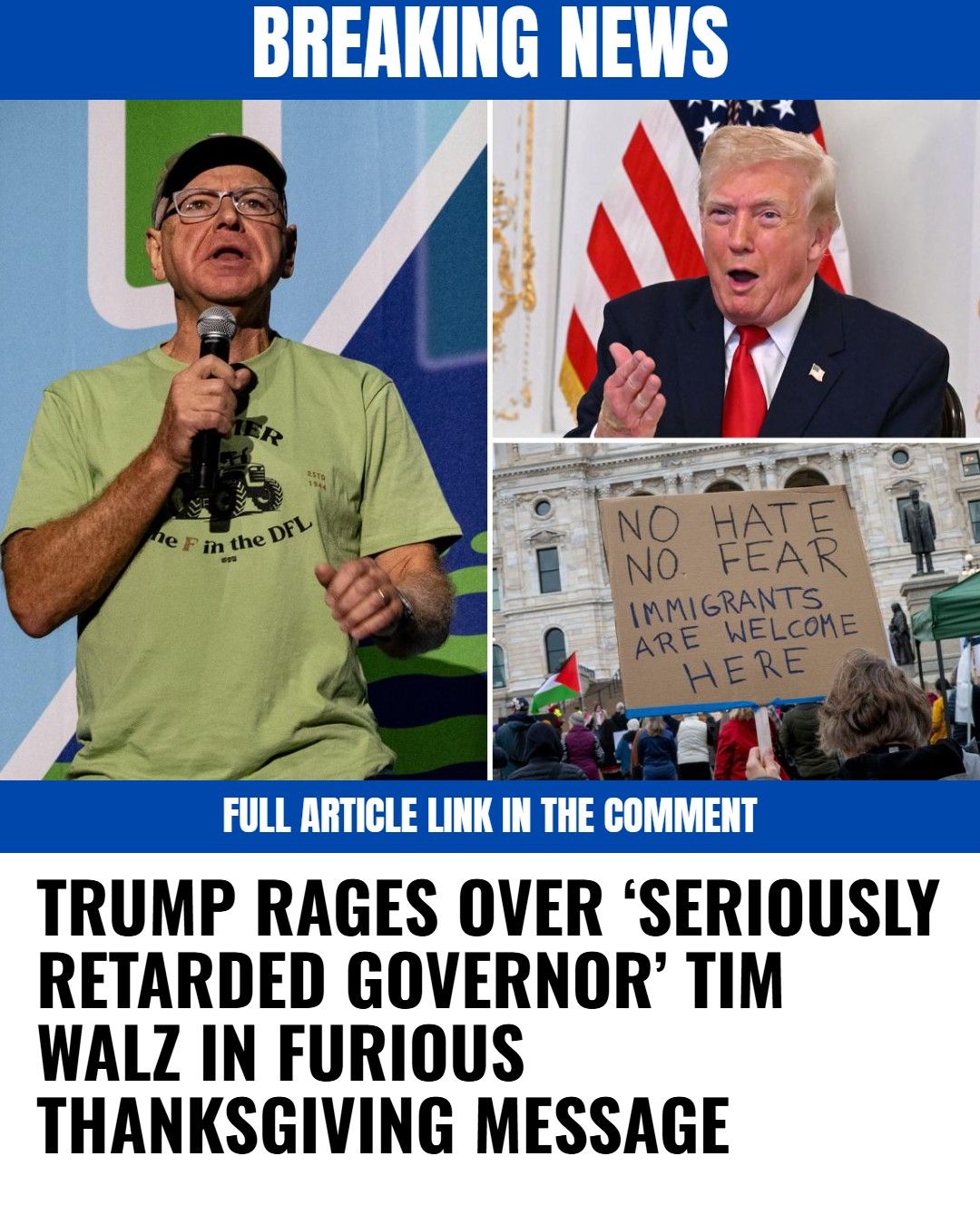
President’s Holiday Post Revives Old Claims and Vows Mass Deportations, Leaving Families Bracing for a New Wave of Uncertainty
The flickering candlelight of Thanksgiving tables across America on November 27, 2025, offered a brief respite from the year’s divisions, as families carved turkey and shared stories of gratitude amid the clatter of silverware and laughter of children. But in the gilded halls of Mar-a-Lago, where crystal chandeliers cast a warm glow over linen-draped spreads, President Donald Trump set aside his plate to compose a message that would shatter the holiday’s fragile peace. Posted to Truth Social at 6:42 p.m., the 500-word declaration began with a nod to “our Great American Citizens and Patriots” but swiftly veered into a blistering critique of immigration and political foes, including a derogatory slur against Minnesota Governor Tim Walz and a revival of unsubstantiated claims about Rep. Ilhan Omar’s entry to the U.S. “Governor of Minnesota, the seriously retarded Tim Walz, does nothing but complain about how badly she is treated,” Trump wrote of Omar, whom he accused of marrying her brother to gain illegal entry—a rumor probed and dismissed by Minnesota authorities in 2016. The post, viewed 15 million times within hours and verified by outlets like BBC, CNN, and NBC, vowed a “permanent pause” on migration from “Third World Countries” and mass deportations of non-citizens seen as burdens, arriving amid the fresh grief of a deadly shooting near the White House that claimed three National Guard lives the day before. For families like those of the fallen Guardsmen, still scattering untouched pies in homes from West Virginia to Charleston, Trump’s words landed with a jarring mix of resolve and raw edge—a holiday missive that amplified their loss while igniting a broader conversation about belonging, blame, and the bonds strained by a nation’s ongoing reckoning.
The post’s tone, unfiltered and urgent, blended seasonal thanks with a sweeping policy blueprint that extended Trump’s first-term travel bans into uncharted territory. “I will permanently pause migration from all Third World Countries to allow for a complete and total recovery of our Country from all of the Illegal Immigration that has taken place,” Trump declared, promising to revoke Biden-era admissions via autopen, strip federal benefits from non-citizens, and pursue denaturalization for those “incapable of loving our Country” or posing security risks. The rhetoric, aimed at an estimated 1.2 million TPS holders from Haiti, Sudan, and Ukraine, echoed the administration’s response to the November 26 Farragut Square ambush, where Afghan immigrant Rahmanullah Lakanwal allegedly gunned down three Guardsmen—Sgt. Michael Harlan, Staff Sgt. Elena Vasquez, and Specialist Sarah Beckstrom—before being subdued. Beckstrom, 20, succumbed to her wounds on November 27, her father Gary at her bedside in MedStar Washington Hospital Center, his voice breaking as he confirmed her passing to reporters. “She fought like hell—squeezed my hand this morning. But it’s a mortal wound; she’s at peace now,” Gary said, his words a quiet eulogy for the young woman who volunteered for the D.C. shift to let others head home for Thanksgiving. Harlan and Vasquez, fathers and mothers from Huntington and Charleston, left behind toddlers clutching drawings of “Daddy with wings,” their losses a fresh wound that Trump’s post sought to cauterize with calls for “reverse migration.”
The personal barbs, woven into the policy vows, revived long-standing allegations against Walz and Omar with a sharpness that drew immediate backlash. Walz, the 2024 Democratic VP nominee and Minnesota governor since 2019, has been a frequent Trump target for his handling of the 2020 George Floyd protests and rural education policies, but the slur—”seriously retarded”—crossed a line that even some Republicans quietly decried. “Tim Walz does nothing but complain about how badly she is treated,” Trump wrote, linking it to Omar, the Somali-born congresswoman who arrived as a refugee in 1992 at age 8. The claim that Omar “illegally” married her brother to enter—a rumor originating in a 2016 Somali-American TV report and investigated by Minnesota officials but dismissed for lack of evidence—has been repeatedly debunked by fact-checkers like The New York Times, which in 2019 found no substantiation despite unverified DNA tests cited by partisans. Omar, a mother of three and vocal advocate for refugee rights, responded on X that evening: “This isn’t leadership—it’s division dressed as gratitude. On Thanksgiving, let’s choose kindness over cruelty.” Walz, attending a family dinner in Mankato, issued a measured statement: “Words like that hurt families, including those with disabilities. We deserve better—focus on unity, not attacks.” Their restraint contrasted the post’s fire, a holiday exchange that highlighted the personal toll of political warfare.
For immigrants like 42-year-old Haitian TPS holder Marie Jean-Baptiste in Miami, the post’s policy core evoked a profound fear, the holiday’s thanks soured by the specter of uprooting. Jean-Baptiste, who fled Port-au-Prince’s gangs in 2011 and now works double shifts at a nail salon to support her U.S.-born son, felt the ground shift as she read the words over cold pie. “I’ve paid taxes, voted, raised my boy here—now, because of where I was born, we’re packing?” she asked, her voice trembling as she showed the alert to a coworker, tears blurring the screen. Haiti’s TPS, extended by Biden in 2024 for 353,000 amid violence that killed 4,000, now faces revocation under Trump’s “reverse migration,” a plan that could strip benefits and trigger removals for non-citizens from nations like Venezuela and Somalia. Jean-Baptiste’s family, her son’s high school diploma a fragile shield, faces separation, her salon—a hub for neighborhood ties—threatened by the tide. “Thanksgiving’s about thanks—how do I give thanks for this fear?” she wondered, her resolve a mother’s fire amid uncertainty. In a Little Haiti church, 200 gathered for prayer that night, voices rising in Creole hymns as Rev. Jean-Marc Pierre linked arms with Marie: “We’ve built lives here—this isn’t thanks; it’s tearing.”
Supporters, from rural Ohio diners to Florida retirement communities, saw the post as a long-awaited stand. In a Toledo eatery, where Trump voters like 62-year-old Jim Hargrove passed phones over pie, the words sparked nods of relief. “It’s overdue—my neighborhood’s changed with folks who don’t integrate, strain our schools. Trump gets the frustration,” Hargrove said, quoting the “net asset” line as the room murmured agreement from those feeling housing crunches. For Hargrove, whose son competes for jobs with recent arrivals, the policy feels like equity—a recalibration after years of perceived openness. Online, #AmericaIsBack trended with 2.8 million posts, supporters sharing stories of “revitalized communities” from rural towns to enclaves where TPS holders had settled amid 2025’s crime uptick.
The blueprint, fusing first-term bans with tools like autopen revocations, targets 1.2 million TPS holders, potentially revoking citizenship for “terrorism” charges—a gray area under the INA that could spark ACLU suits. “This is recovery from damage—illegal immigration has hurt our Country badly,” Trump wrote, citing 2.5 million encounters since 2021. Supporters like Rep. Marjorie Taylor Greene hailed it as “sovereignty,” her post garnering 1.2 million likes. Critics, including Sen. Jeanne Shaheen, decried “overreach,” her bill for SIV fast-tracks stalling.
As December dawns, with reviews for January 2026, the post’s legacy unfolds in reckonings—families like Jean-Baptiste’s packing boxes, supporters like Hargrove toasting “first.” Trump’s words, raw as holiday talk, invite reflection: Gratitude for welcome, tempered by protection for those here. In Miami churches and Minneapolis markets, thanks endures—in hands extended across tables, family the true feast.
To provide the best experiences, we use technologies like cookies to store and/or access device information. Consenting to these technologies will allow us to process data such as browsing behavior or unique IDs on this site. Not consenting or withdrawing consent, may adversely affect certain features and functions.
Functional Always active
The technical storage or access is strictly necessary for the legitimate purpose of enabling the use of a specific service explicitly requested by the subscriber or user, or for the sole purpose of carrying out the transmission of a communication over an electronic communications network.
Preferences
The technical storage or access is necessary for the legitimate purpose of storing preferences that are not requested by the subscriber or user.
Statistics
The technical storage or access that is used exclusively for statistical purposes.The technical storage or access that is used exclusively for anonymous statistical purposes. Without a subpoena, voluntary compliance on the part of your Internet Service Provider, or additional records from a third party, information stored or retrieved for this purpose alone cannot usually be used to identify you.
Marketing
The technical storage or access is required to create user profiles to send advertising, or to track the user on a website or across several websites for similar marketing purposes.